
50 signed and numbered prints
20″ x 30″
$345.00
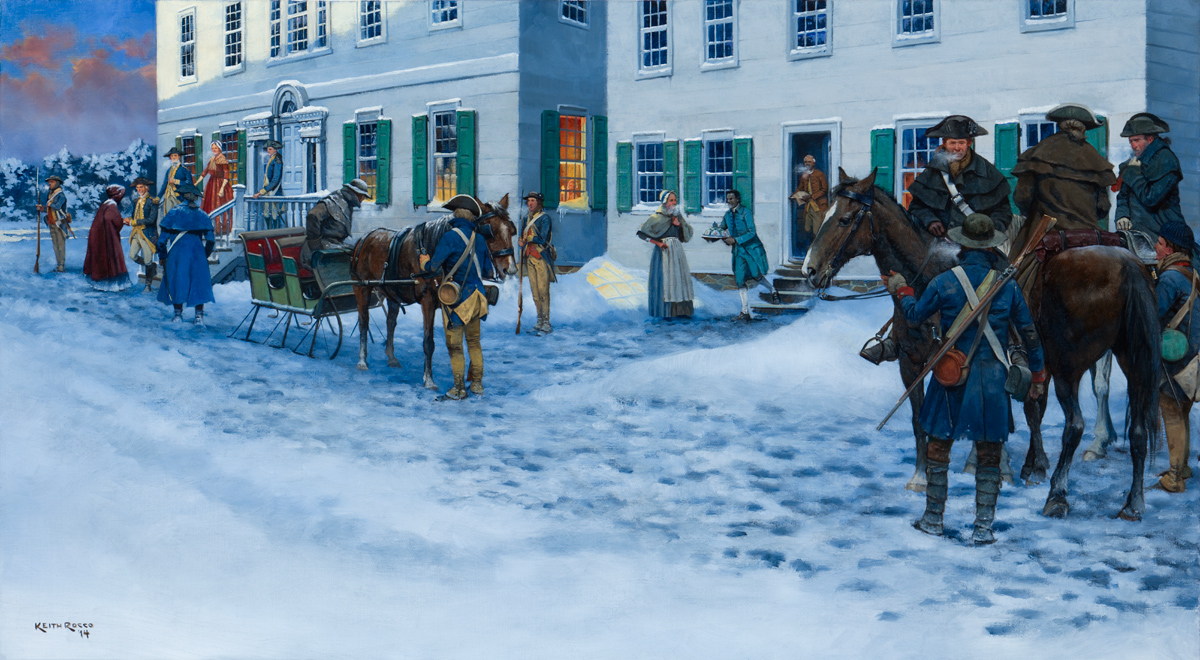
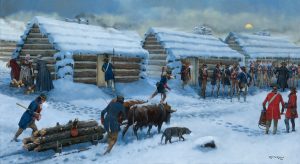
Ford’s Mansion, Morristown, NJ – Theodosia Ford, widow of Jacob Ford Jr., a colonel in the local militia, allowed Gen. Washington to use her large home as his headquarters. On New Year’s Eve 1779, Martha Washington, shown here dressed in red, arrived by sleigh to spend the winter with her husband. Many soldiers were accompanied by wives and children. Over the course of the Revolutionary War, Martha Washington spent more than 50 months at the front with her husband in encampments at Boston, Valley Forge, Philadelphia, Morristown, and Newburgh. She assisted with household duties, visited hospitals, and helped inspire broader efforts to support soldiers in the field. As the most famous of all so-called “camp followers,” Martha Washington’s work helped legitimize the presence of women in the camps. At the brutal camp at Valley Forge (1777-1778), as many as 400 women supported the 12,000 men in the encampment. The work was perilous; nearly 2,000 men died of disease that winter.
The following winter, hastily built additions to Ford mansion provided an office for the aides and a kitchen for the headquarters. Servants and slaves tended to domestic duties. Military guards stood watch over a constant stream of visitors. Washington wrestled with the problems of the army and the precarious coalition of states that was not yet a nation. The Continental Congress could not fund the army, and ruinous inflation made the purchase of badly needed food and clothing almost impossible. The general sought help from neighboring states. The response from New Jersey was immediate and generous; it “saved the army from dissolution, or starving,” wrote Gen. Washington. In May 1780 the Marquis de Lafayette arrived at the Ford Mansion with welcome news of aid from France. The next month the camp dispersed, as the last of the troops were ordered into battle yet again.
| Medium | |
|---|---|
| Type | |
| Size | 20" x 30" |